Kota Stone, Marble, or Tile: What Actually Belongs on a Hyderabad Floor
Marble is not the default premium choice for a Hyderabad floor. A good Kota piece, the city's climate, and the real cost of upkeep tell a very different story than the stone showroom will.

It is a Thursday afternoon in late April and the outside temperature in Hyderabad has just crossed 40 degrees. Inside a Jubilee Hills villa, a woman walks barefoot from a cotton dhurrie onto the cool surface of a Kota stone floor, and she does not need to think about why it feels good. Kota stone flooring is a fine-grained, dense limestone quarried in Rajasthan, India which stays several degrees cooler than the ambient indoor temperature because of its natural thermal mass. Marble, walked on at the same moment in the same climate, behaves very differently. And porcelain tile, for all its showroom precision, behaves differently again.
Most homeowners in Hyderabad default to marble because it reads as expensive. That is the wrong reason to choose a floor. The right reason is how the floor lives with the climate, your upkeep habits, and the home's use for the next twenty years.
What Kota Stone Actually Is
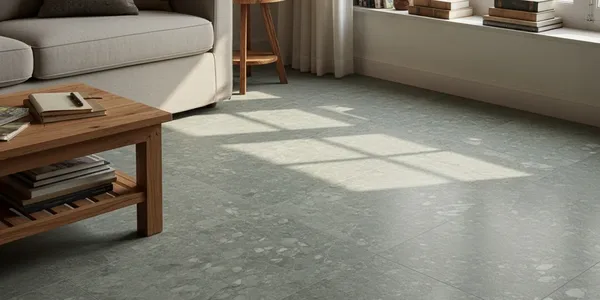
Kota is a sedimentary limestone, quarried primarily around Ramganj Mandi in Rajasthan's Kota district. It comes in shades of pale green, grey-green, brown, and occasional blue-grey, with a characteristic fine grain and a subtle sheen when polished. The slabs have natural variation, which is what gives a Kota floor its honest, lived-in quality.
A handpicked Kota slab from the yard, with a consistent grain and no hairline cracks, is a very different material from the machine-cut, standardised tile you find at a city showroom. Both are technically Kota stone. They do not read the same in a room.
What Marble Promises and What It Costs
Marble is the default aspirational floor in Indian homes. White Makrana, Italian Statuario, Rajnagar, Morwad: the showroom names carry weight. In the right villa, a polished marble foyer is stunning.
What the showroom does not say out loud is that marble is porous. Turmeric, lemon juice, red wine, a dropped bottle of Dettol, all leave stains that require professional polishing to remove. Marble also needs re-polishing roughly every three to five years to hold its finish in a high-footfall Hyderabad home, which runs between Rs 35 and Rs 80 per square foot each cycle. Over a twenty-year horizon, that upkeep cost quietly surpasses the original material cost.
Why Tile Deserves a Second Look
Large-format porcelain tile, the 800x1600 mm category in particular, has gotten good enough over the last five years that the stone snobbery around it is outdated. The best porcelain tile from Kajaria, Somany, or Italian imports from Florim and Atlas Concorde is rectified, stain-resistant, and visually convincing enough that most guests will not know it is not stone.
Tile wins on maintenance: it is non-porous, stain-proof, and needs nothing more than a wet mop. It loses on feel: a bare foot knows the difference between ceramic and limestone. Where you prioritise, and where you do not, is the actual design question.
The Hyderabad Climate Test
Hyderabad's microclimate is hot and dry for most of the year, with monsoon humidity spiking from June through September. Indian Meteorological Department (IMD) Hyderabad records show peak summer temperatures averaging 39 to 41 degrees Celsius in April and May, with ground-level radiant heat inside top-floor apartments and west-facing villas often exceeding that.
"Our material sourcing principle is simple. The floor should work hardest in the season your home is hardest to live in. In Hyderabad, that season is May. Kota stays cool in May. Marble gets cool but stains first. Tile is neutral on temperature and neutral on feel."
The Comparison
On the Kota stone vs marble question, here is how the two sit side by side, across the criteria that decide how a floor performs in a Hyderabad home over twenty years:
| Criterion | Kota Stone | Makrana Marble | Large-Format Porcelain Tile |
|---|---|---|---|
| Material cost (installed, Rs/sq ft) | 90 - 160 | 240 - 600+ | 120 - 350 |
| Summer surface feel | Cool, stays cool | Cool initially, warms up | Neutral |
| Monsoon humidity behaviour | Unaffected | Can develop hazing | Unaffected |
| Stain resistance | Moderate (seal every 2 yrs) | Poor (porous) | Excellent |
| Re-polishing cycle | Every 5 - 7 yrs | Every 3 - 5 yrs | Not required |
| Lifespan in a Hyderabad home | 30+ years | 20 - 25 years | 15 - 20 years |
| Where it shines | Living, dining, verandah | Foyer, formal spaces | Kitchen, bathrooms, balcony |
The table is not a verdict. It is a way to decide which room gets what. A Hyderabad home does not need a single flooring material. A good one usually has two, sometimes three, chosen by how each room actually gets used.
How We Choose for a Client's Home
At Nilaya, the flooring conversation usually starts with a question. We ask where the client stands barefoot most often. That room almost always wants Kota. The formal entry where shoes come off and guests are received often wants marble, because the ritual of arrival deserves a material that announces it. The kitchen and bathrooms want tile, because water and turmeric are not sentimental. We rarely run a single material across the whole home, and we almost never choose the flooring before we choose the palette, because the floor sets the warmest note of everything above it. Of course, in modern flats and villas sometimes builders do not allow you to change the flooring. You have to live with the vitrified tiles provided by the builder in those cases.
Frequently Asked Questions
- Is Kota stone better than marble for Indian homes?
- When people ask what the best flooring for Indian homes is, the honest answer for most Indian climates, including Hyderabad, is that Kota stone is more practical than marble on cost, lifespan, and stain tolerance. Marble reads more luxurious in formal spaces but demands upkeep Kota does not. The right answer is often both, used in different rooms.
- How long does Kota stone flooring last?
- A well-installed, sealed Kota stone flooring in a Hyderabad home lasts thirty years or more with basic care. The stone itself outlives the building's finish, which is why you see Kota in public buildings from the 1970s still looking honest today.
- What does Kota stone flooring cost per square foot in Hyderabad?
- Installed Kota stone flooring in Hyderabad ranges from Rs 90 to Rs 160 per square foot as of early 2026, depending on slab quality, thickness (25 mm vs 30 mm), and whether you are using factory-cut tiles or yard-picked slabs. Yard-picked costs more but looks visibly better.
- Can I use Kota stone flooring in a kitchen?
- Kota works in a kitchen if sealed properly, but it is porous enough that a dropped cup of turmeric can stain. For a busy Indian kitchen, we usually recommend large-format porcelain tile on the floor and reserve Kota for the living and dining spaces.
- Is marble flooring a bad idea for Hyderabad homes?
- Not bad, but often overchosen. Marble makes sense in the foyer, the formal living, or a dressing room where visual grandeur matters and spills are rare. Running marble across the kitchen or children's rooms is where most homeowners later regret the choice.
- What about wooden flooring for Hyderabad?
- Engineered wood can work in bedrooms and studies, where humidity and footfall are lower. For living and dining spaces in Hyderabad's climate, stone or tile is more practical than solid or engineered wood, which can buckle during monsoon if not well-installed.