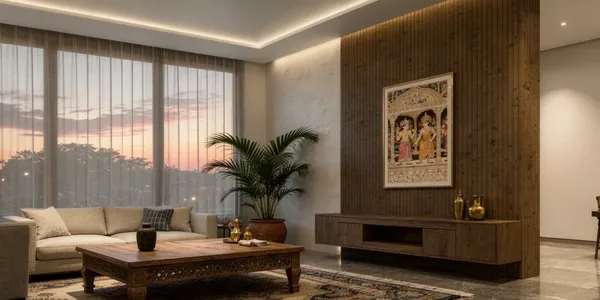
Layered Lighting in Hyderabad Apartments
Most new apartments in Hyderabad and most other cities come with four builder lights. Here is what you actually need across five distinct lighting layers, and why the difference matters at 7pm.
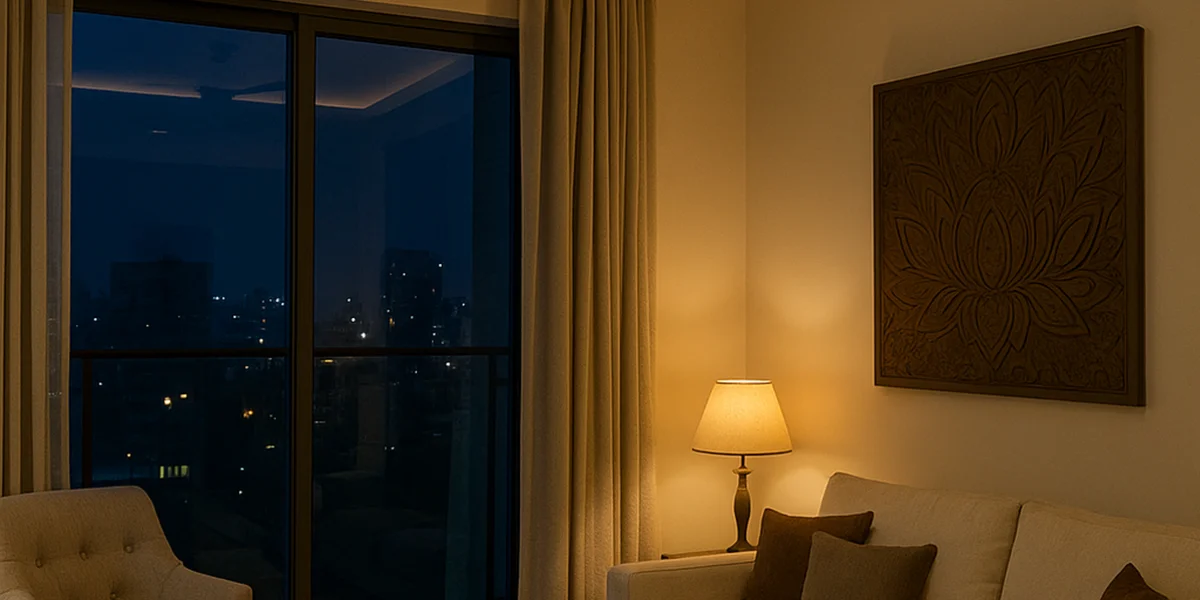
You collect your keys in the afternoon, when every room glows with natural light through floor-to-ceiling windows. The flat looks spacious, warm, honest. You move in three weeks later. By 7pm on the first evening, something feels wrong. The rooms are lit, technically, but the builder's four recessed spots flatten everything into an office. Layered lighting apartment design in Hyderabad solves exactly this problem: replacing a single-plane ceiling grid with five distinct types of light, each doing a different job at a different hour.
Why Builder Lighting Fails After Dark
Most developers in Hyderabad install between four and six recessed downlights per room at a standard 2700 to 3000K colour temperature. The result is uniform, flat, practical illumination that serves site visits beautifully and evening living poorly. Downlights cast light straight down, creating harsh shadows under cheekbones, washing out furniture texture, and eliminating the sense of depth that makes a room feel settled. The energy is clinical. You notice it most when guests arrive.
The reason builder lighting prioritises this layout is procurement, not design. A single fitting type ordered in bulk, installed by an electrician on a fixed schedule, signed off in a single inspection. The economics work for the developer. They do not work for the household that lives in the flat for the next decade.
The First Three Layers: Ambient, Task, Accent
Lighting designers use a framework that has been standard in hotel and residential design for decades: ambient, task, and accent. Each layer operates at a different height, intensity, and purpose.
Ambient light is your base layer: the general illumination that replaces daylight. In Hyderabad apartments with false ceilings, this is typically cove lighting running along the perimeter at 4000K, giving a soft upward wash that bounces off the ceiling rather than stabbing downward. The cove channel is usually 75 to 100mm deep, hidden behind a shadow gap, with a continuous LED strip running 9 to 14 watts per metre. It sets the room's overall tone without creating glare.
Task light is positioned close to where you actually work: a reading lamp beside the sofa, a pendant above the dining table at eye-plus-30cm height (typically 750 to 850mm above the table surface), under-cabinet strips in the kitchen at 4000 to 5000K for accurate colour rendering when chopping. The Bureau of Indian Standards recommends 300 to 500 lux for reading and 500 lux for kitchen work surfaces. A single ceiling fixture cannot deliver this without lighting the entire room at uncomfortable intensity.
Accent light is the layer that turns a finished room into a composed one. A small spotlight aimed at a painting at a 24 or 36 degree beam angle, a warm LED strip behind a bookshelf, a wall washer grazing a textured limewash wall to bring out the surface. These create pools of interest that give a room visual hierarchy and make it feel deliberately composed rather than incidentally lit. Accent fittings are typically low-wattage (5 to 10W LED) but high-impact because they target a single object or surface.
Layered lighting only works when each layer can be controlled independently, because the ambient cove and the decorative table lamp need to operate at different intensities at different hours.
The Fourth Layer: Decorative Light
Decorative light is the layer that exists for the eye, not for the room's task or perimeter. A brass table lamp on the side console, a paper pendant low over the dining table, a pair of candle-style sconces on the bedroom wall behind the headboard, a sculptural floor lamp anchoring a reading corner. These fittings are read first as objects and only second as light sources. When the bulb is off, they hold the room together compositionally. When the bulb is on, they pull warmth into the corners that ambient and accent layers cannot reach.
In Hyderabad apartments, decorative light is the layer that earns its place in the months after move-in, when the room starts to reveal what it needs at human eye level. Designers plan decorative fittings into the lighting brief from the start, alongside the bones: where the table lamp will sit, what the cord routing will be, which switch controls it. The result is a room that reads composed at every hour rather than only by daylight. A 25W or 40W warm-white E27 LED bulb in a sculptural shade is enough. The wattage stays small because the role here is to populate the room with light sources at human eye level, not to illuminate it.
The fittings themselves carry a second job. A brass urli-style table lamp, a Channapatna-turned wood floor lamp, a hand-thrown ceramic base, a paper lantern from a Kashmiri craftsperson: these are objects that age into the room and tell the room's specific story. Decorative lighting is where Nilaya's quiet-luxury principle most often shows: the lamp is read as a small piece of considered craft, and the light it throws is the bonus.
The Fifth Layer: Controls and the Evening Sequence
The fifth layer skips fittings altogether: it is the wiring logic and the dimmers that let the first four layers behave as one room rather than four overlapping rooms. The default builder wiring puts every fitting in a room on a single circuit, which means every fitting comes on at full intensity together. Layered lighting only works when each layer can be controlled independently, because the ambient cove and the decorative table lamp need to operate at different intensities at different hours.
The minimum useful upgrade is a two-circuit setup: separate the ambient cove from the rest, and put a dimmer on at least the cove circuit. The cost addition is small relative to the overall electrical work, and the perceptual change in the room is large. The next step is per-layer dimming: ambient on one dimmer, task on another, accent and decorative on a third. This gives the operator three intensity sliders that can be shifted to match the hour, the activity, and the company.
The evening sequence in a Hyderabad living room typically reads like this. At 5pm, cove at 80% as natural light fades. At 6pm, cove down to 60% with task lamps on. At 7pm, cove at 40% with accent washers brought in. At 9pm, cove off, table lamp and accent only. This is what designers mean when they say a room should wear the day. A single switch cannot do this.
Smart controls (Keus, Lutron RA2, Schneider Electric Wiser, Anchor by Panasonic, and several other Indian-market brands) can pre-program these scenes onto a wall keypad or phone app. They are excellent if you want push-button scene recall. They are not necessary. A wall plate with three rotary dimmers does the same work, costs a fraction, and the wiring runs are familiar to any Hyderabad electrician.
Hyderabad-Specific Considerations
The city runs warm for six to eight months of the year. Residents in west-facing flats in Nanakramguda for instance experience direct afternoon sun until 6pm, which means the transition from daylight to artificial light is particularly abrupt. A dimmer-controlled cove layer that you bring up gradually from 4pm makes this transition almost imperceptible. In east-facing master bedrooms, the same logic applies in reverse: you want warm, low-intensity ambient light that does not shock the body into alertness at 10pm when you are winding down.
During monsoon weeks, the city stays overcast from morning through afternoon. The ambient layer needs to do more work for longer hours, which is where dimmer headroom matters: a circuit running at 60% on a typical evening may need to run at 90% on a grey 11am Saturday in July without the lamps being driven to their maximum.
Atomberg, Havells, and other brands in India now make ceiling fans with integrated warm-white LED rings that serve double duty: functional air movement plus soft overhead diffusion, without the need for a separate light fitting in a bedroom where a pendant would compete with the fan. This is a practical detail most showrooms will not tell you, because they are selling fittings, not solutions.
Apartment ceiling heights in Hyderabad typically run 9 to 10 feet (2.7 to 3.05m) at the slab and 8 feet 6 inches (2.6m) after the false ceiling drops 75 to 100mm for the cove channel. This is a meaningful constraint. Pendant fittings selected for an 11ft showroom ceiling will hang too low in a real apartment, intruding on sightlines from the sofa. Designers select pendants and chandeliers with a hanging length that respects the actual finished ceiling height, which is rarely the height shown in the developer's brochure.
Colour Temperature Is Not a Style Choice
Warm light (2700 to 3000K) relaxes. Cool light (5000 to 6500K) alerts. This is biology, not aesthetics. A 2019 study published in the Journal of Environmental Psychology found that colour temperature directly affects perceived room temperature and emotional arousal, with cooler light increasing alertness by measurable margins. In a bedroom or living room used in the evening, the builder's default 4000K downlights are working against the room's purpose. Switch the cove to 2700K, add a 2700K table lamp in a corner, and the same space reads as a different flat.
A second specification that matters as much as colour temperature is colour rendering index (CRI, sometimes labelled Ra). For residential use, look for Ra of at least 80, ideally 90 and above for kitchens and dressing areas. A Ra of 80 means colours look natural; a Ra of 70 (common in cheap LED imports) makes skin tones, fabrics, and food look slightly off, in a way most occupants notice without being able to name.
How Many Points Do You Actually Need
A 1600 sq ft, three-bedroom apartment in Gachibowli typically requires between 18 and 24 light points across all rooms for proper layered lighting across the five layers: 4 to 6 cove or perimeter points (ambient), 4 to 6 task points, 3 to 5 accent points, 3 to 5 decorative fittings, plus the dimmer and circuit work for controls. The builder typically installs 4 to 6 total. That gap decides whether a flat looks finished or actually feels like home; decoration has little to do with it.
The sequencing matters too. Light points need to be planned before false ceilings are closed, which means before most buyers are even thinking about furniture. Cove channels especially are a one-shot: once the false ceiling is plastered and finished, retrofitting a cove involves cutting back the ceiling, which is expensive and disruptive. If you are taking possession in the next 30 to 90 days, this is the conversation to have with your interior designer in Gachibowli (or wherever your flat is) now, not after the plasterer has left.
Sources & References
- Lux level standards for residential interiors: The 300 to 500 lux range cited for reading and 500 lux for kitchen work surfaces follows Indian residential illumination guidance. Bureau of Indian Standards (BIS).
- Colour temperature and emotional arousal: The 2019 finding that cooler colour temperatures measurably increase alertness while warmer temperatures support relaxation is drawn from environmental psychology research on lighting and behaviour. Journal of Environmental Psychology.
- Colour Rendering Index (CRI / Ra): The Ra metric and its 80-and-above residential threshold are defined by the international lighting commission. Commission Internationale de l'Eclairage (CIE).
- Channapatna craft tradition: Channapatna-turned wood is a geographically indicated lacquerware craft from Karnataka, often used for decorative lighting bases and homeware. Channapatna toys (Wikipedia).
Frequently Asked Questions
- Can I add layered lighting after the false ceiling is already done?
- Yes, with limits. Cove lighting requires a recessed cavity, which is hard to add retrospectively without reopening the ceiling. Table lamps, floor lamps, plug-in accent lights, and surface-mounted track spots can layer onto any existing setup. The best results come from planning before the ceiling closes.
- What is the difference between accent light and decorative light?
- Accent light points at something: a painting, a sculpture, a textured wall. It exists to draw the eye to that object. Decorative light is the object itself: a table lamp, a sculptural pendant, a sconce. It exists to populate the room with intentional fittings, whether the bulb is on or off. A well-layered room uses both.
- Do I need a lighting designer separately?
- Not necessarily. A good interior designer handles lighting as part of the brief. The risk with separating them is that the lighting plan and the furniture plan end up in conflict, with pendants positioned where a bookshelf was meant to go, or task lamps without a power point within reach.
- Is warm light suitable for the kitchen?
- Warm ambient light works well in the kitchen for atmosphere, but task lighting above the counter and inside the hob area should stay at 4000 to 5000K with Ra of 90 or above for accurate colour rendering when you are chopping and cooking. The two layers operate independently.
- How do I control multiple layers, and are smart lighting systems worth the cost?
- A basic two-circuit setup separating cove from downlights costs very little more than a single circuit and gives you meaningful control. Adding a dimmer on each circuit gives another dimension. A wall plate with three rotary dimmers (one per layer cluster) is the practical sweet spot for most apartments. Full smart lighting becomes useful when you have more than five or six addressable circuits in a room, want scene recall on a single button, or want voice control. For most three-bedroom apartments, three rotary dimmers per main room deliver 90% of the benefit at a fraction of the cost. Consider smart only after you have lived with the manual layered setup for six months and identified what is actually missing.
- Does lighting colour temperature affect electricity bills?
- No. Colour temperature is a property of the light quality, not the wattage. An LED bulb at 2700K and one at 5000K consume the same electricity at the same wattage. Switching to warm light does not increase your bill.